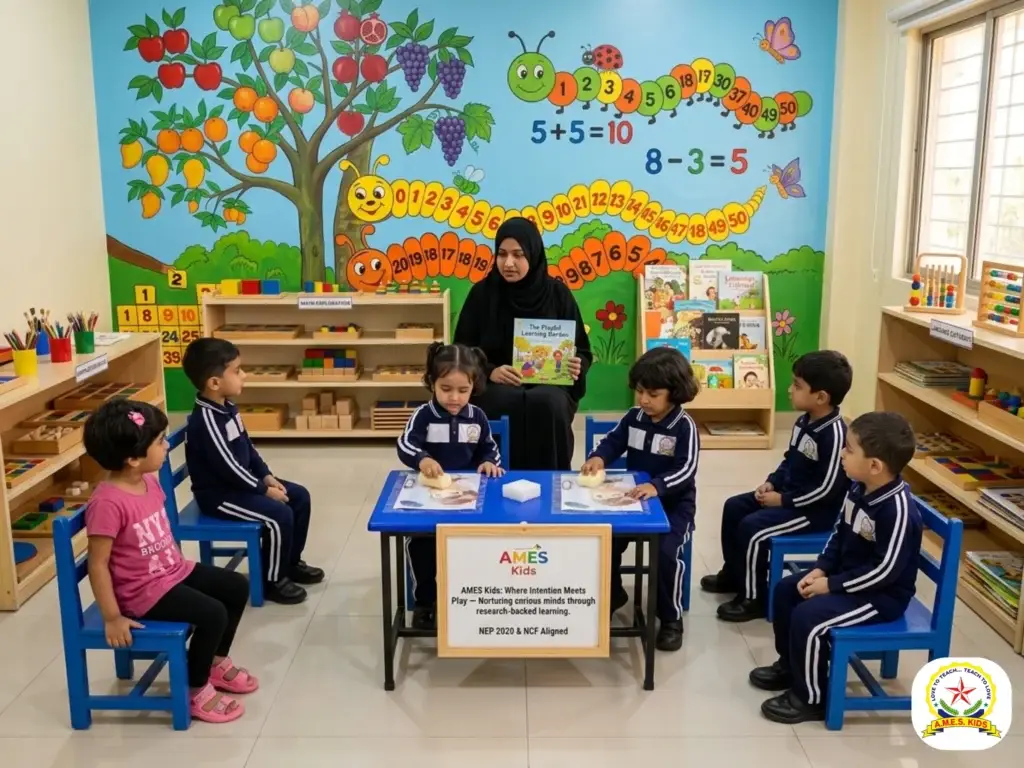
There is a question that almost every parent asks at some point during the early years—usually after their child comes home happy and a little muddy, describing a day that sounded suspiciously like fun. The question is: “But are they actually learning?”.
At AMES Kids, the answer is a wholehearted yes. We are not just teaching; we are helping children learn deeply, joyfully, and in ways that stick.
Play is Not the Opposite of Learning—It is Learning
Decades of research in developmental psychology, neuroscience, and education have overturned the old idea that “real” learning only happens while sitting quietly at a desk. The human brain was designed to learn through play during the early years.
Scientific Exploration: A three-year-old filling and tipping a cup of sand is exploring volume, capacity, and cause and effect.
Social & Mathematical Logic: Five-year-olds negotiating roles in a “market game” are practicing language, conflict resolution, and working out prices.
Resilience: A child rebuilding a fallen tower is practicing the essential human skill of trying, failing, reflecting, and trying again.
What Play-Based Learning Looks Like in Practice
In the Early Years (Nursery, LKG, UKG)
Nursery: Pouring water through funnels to discover how the same amount of liquid looks different in different shapes—an early encounter with “conservation of volume”.
LKG: Building a “vegetable market” corner where children write price tags and bargain, blending literacy and numeracy into one joyful interaction.
UKG: Nature walks to collect and sort leaves by size and shape, weaving science, mathematics, and art together.
In the Foundation Years (Grade 1 & Grade 2)
Community Planning: Grade 1 students map their neighborhoods to identify how to make them safer or greener, building EVS and civic awareness.
Engineering: Grade 2 learners investigate bridge strength using paper, tape, and weights to experience the joy of “figuring it out”.
Storytelling: Collaborative projects where children write and perform their own stories, building literacy through creative expression.
The Role of the Educator
Our teachers are not bystanders. They are careful observers and skilled facilitators who know exactly when to step back and when to ask a “provocation” question that stretches a child’s thinking. This requires a deep respect for the child’s agency and a trust in a learning process that often looks “messier” than a worksheet.
Research and Faith: A Shared Vision
Scientific studies consistently show that children who learn through play develop stronger executive function and better language skills than those pushed into formal instruction too early.
Our Islamic tradition also speaks beautifully to this. Prophet Muhammad (Peace and Blessings be upon him) was known to play with children and understand their need for joy and movement. We believe a happy, secure, and engaged child will always learn more than one who is anxious or bored.
“We called AMES Kids when we were looking for an environment that truly understands early childhood development. They were able to show us how play is intentionally structured to build critical skills. My child is not just happy; they are gaining a deep love for discovery that is visible every single day.”
Tips for Families at Home
Let them play freely: Provide time without screens or fixed outcomes.
Change the question: Ask “What did you make today?” rather than “What did you learn?”.
Provide open-ended materials: Blocks, clay, paint, water, and sand allow for infinite discovery.
Follow their lead: Play alongside your child, but let them direct the action.
Trust the process: The learning is happening, even when it isn’t visible on a piece of paper.